
As batteries were beginning to be mass-produced, the cell shape changed to the cylindrical format. The F cell for lanterns was introduced in 1896 and the D cell followed in 1898 to the C cell followed in 1900, and the popular AA was introduced in 1907. And nowadays, there are many different shapes of lithium batteries availalbe on the market, but the most common shape is cylindrical, prismatic and pouch cells.

Cylindrical Cell
The cylindrical cell continues to be one of the most widely used packaging styles for primary and secondary batteries. The advantages are ease of manufacture and good mechanical stability. The tubular cylinder can withstand high internal pressures without deforming.
Many lithium and nickel-based cylindrical cells include a positive thermal coefficient (PTC) switch. When exposed to excessive current, the normally conductive polymer heats up and becomes resistive, stopping current flow and acting as short circuit protection. Once the short is removed, the PTC cools down and returns to the conductive state.
Most cylindrical cells also feature a pressure relief mechanism, and the simplest design utilizes a membrane seal that ruptures under high pressure. Leakage and dry-out may occur after the membrane breaks. Re-sealable vents with a spring-loaded valve are the preferred design. Some consumer Li-ion cells include the Charge Interrupt Device (CID) that physically and irreversibly disconnect the cell when activated to an unsafe pressure builds up. Figure 1 shows a cross section of a cylindrical cell.
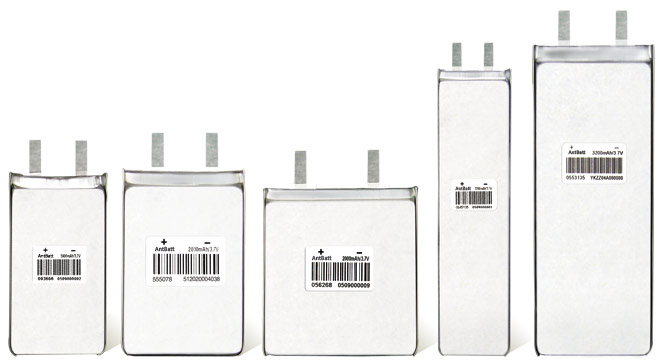
The pouch cell offers a simple, flexible and lightweight solution to battery design. Some stack pressure is recommended but allowance for swelling must be made. The pouch cells can deliver high load currents but it performs best under light loading conditions and with moderate charging.
The pouch cell makes most efficient use of space and achieves 90–95 percent packaging efficiency, the highest among battery packs. Eliminating the metal enclosure reduces weight, but the cell needs support and allowance to expand in the battery compartment. The pouch packs are used in consumer, military and automotive applications. No standardized pouch cells exist; each manufacturer designs its own.
Pouch packs are commonly Li-polymer. Small cells are popular for portable applications requiring high load currents, such as drones and hobby gadgets. The larger cells in the 40Ah range serve in energy storage systems (ESS) because fewer cells simplify the battery design.
Although easily stackable, provision must be made for swelling. While smaller pouch packs can grow 8–10 percent over 500 cycles, large cells may expand to that size in 5,000 cycles. It is best not to stack pouch cells on top of each other but to lay them flat, side by side or allow extra space in between them. Avoid sharp edges that can stress the pouch cells as they expand.
Extreme swelling is a concern. Users of pouch packs have reported up to 3 percent swelling incidents on a poor batch run. The pressure created can crack the battery cover, and in some cases, break the display and electronic circuit boards. Discontinue using an inflated battery and do not puncture the bloating cell in close proximity to heat or fire. The escaping gases can ignite. Figure 7 shows a swollen pouch cell.